Suckling
2024.11.13
At what point did I stop simply existing innocently and change into a person who can’t help but analyze? I know in my heart that when I was a kid, it wasn’t like that. I had fun, laughed, and screamed—I didn’t think about it. Nowadays, even when I’m enjoying something, I end up thinking about enjoying that thing. Thinking is a good thing, yes, but I wish I could return to pure experience. I’m envious when I see kids playing freely.
What’s interesting is that thoughts are often seen as providing meaning in some way. Maybe that’s not entirely true, but the word “meaning” itself used to signify, in Old English, the intent or thought behind something. Meaning was once reliant on thoughts. Nowadays, the definition has shifted to include intention, significance, and purpose. And what’s interesting about that is these things aren’t always dependent on thought. You might assume they are, but they aren’t.
There is meaning embedded within our culture—significance and understanding that persist among people, even when they aren’t consciously thinking about it. It may not even occur at a subconscious level. For instance, consider how people eat their food: some use their hands, others use chopsticks, forks, or knives. We don’t think about this when we’re eating, yet there is meaning behind these customs, even if we’re not aware of it. Intentions can persist through time. Someone invented a fork and knife, imbued them with thought, with meaning. Even though that original thought no longer exists, the utensils still persist.
I think I yearn for that in some way. I hope that what I do has meaning—not just for me but for others to come, so that some part of me persists. I believe that this desire is both impossible and highly probable. It’s hard to exist in this world without some part of you persisting through it. Even if you were never born, your existence has an impact.
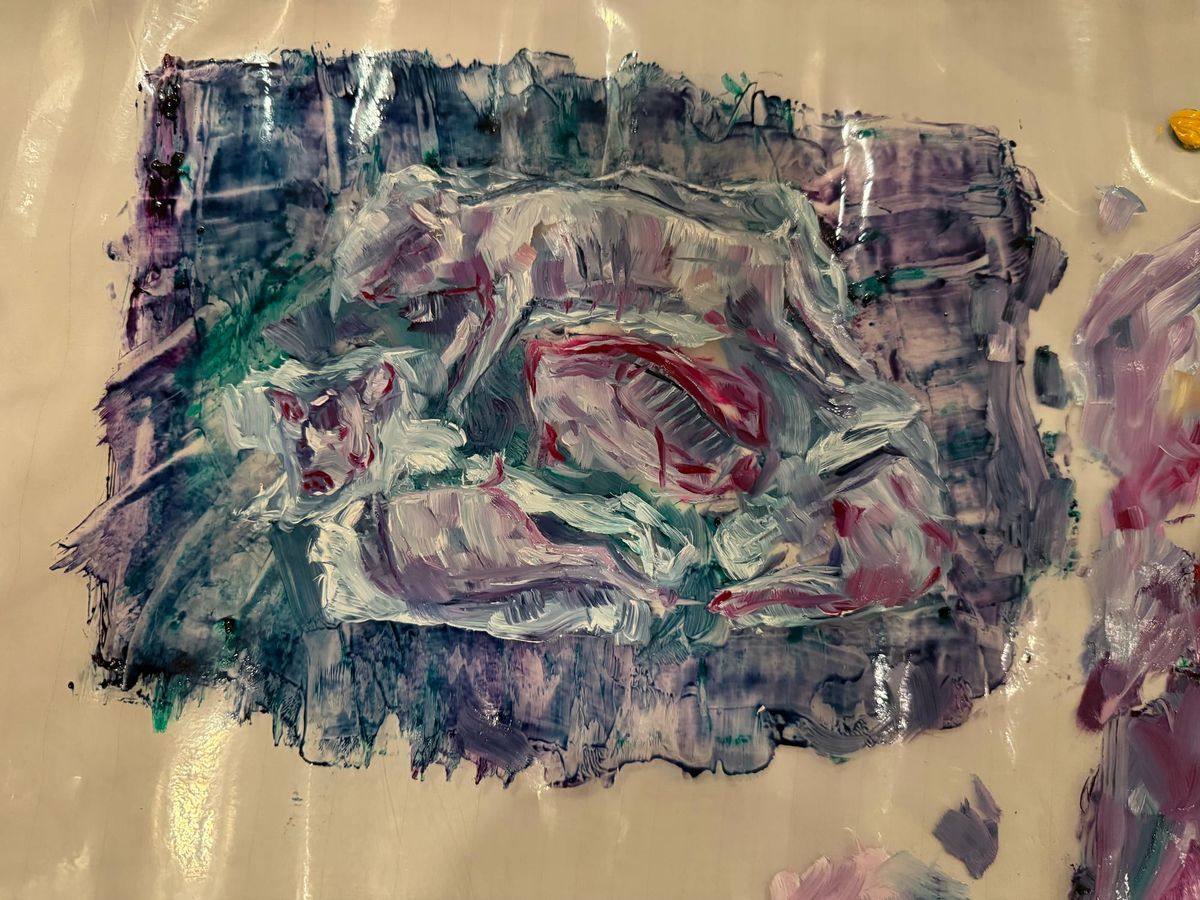
Today, I drew or painted a suckling pig, which is a baby pig that feeds on its mother’s milk. These babies are killed between two to six weeks of being alive. I’m not here to shame anyone for eating meat—I used to be one of the biggest meat eaters. While I’m here in the Philippines, I’m still eating fish. Sometimes, even when there is a veggie dish available, I’ll still choose the fish option because I’ve allowed myself to eat it.
Still, I can’t help but feel sorry for the suckling. I almost feel like when we kill them in this way, we don’t honor them. We don’t appreciate them. We don’t think of them as living beings. I empathize with that; I see myself in that. The photo I saw online, which I tried to paint but didn’t get very far with, showed the different parts of the suckling pig arranged decoratively around its own body. I suppose it was actually two different sucklings. The image seemed so heavy. The person who prepared it probably took pleasure in making it look aesthetically pleasing.
Yet in some ways, that pig’s life—its meaning—has unfortunately been defined by this interaction. Its life has been reduced to aesthetics, or worse, someone else’s aesthetics. Of course, I am probably personifying the suckling too much. But it does make you think about your own life and its perceived meaninglessness.